
bLOG
What Expenses Can a Plumber Claim on Tax in the UK?
- Home
- Blog
- What Expenses Can a Plumber Claim on Tax in the UK?
A self-employed plumber can claim genuine business costs such as tools, plumbing materials, qualifying van costs, protective clothing, business insurance, relevant training and administration expenses.
For your 2025/26 Self Assessment, the key is not just knowing what appears on an expense list. You also need to know how HMRC expects you to treat mixed personal use, van mileage, equipment and costs connected with the Construction Industry Scheme.
Get those distinctions right and your taxable profit should reflect the real cost of running your plumbing business.

The golden rule: claim only genuine business costs
HMRC’s starting point is that a business expense must be incurred for the purposes of your trade. If an identifiable part of a cost relates to the business and another part is private, you can sometimes separate and claim the business portion.
That matters for plumbers because many common costs have mixed use.
Your mobile might be used for customer calls and personal calls. Your van might cover plumbing jobs and weekend trips. A laptop might handle invoices as well as personal browsing.
Claim the identifiable business part rather than automatically putting the full bill through the business.
There is another trap for the 2025/26 tax year. The trading allowance is up to £1,000 for the 2025/26 tax year, but if you elect to use that allowance, you cannot also deduct your actual business expenses and capital allowances.
For a plumbing business with materials, tools and van costs, compare the two methods before choosing.
You can also check an individual cost with Hammer & Ledger Tax’s Allowable Expenses Calculator.
Tools and equipment plumbers can claim
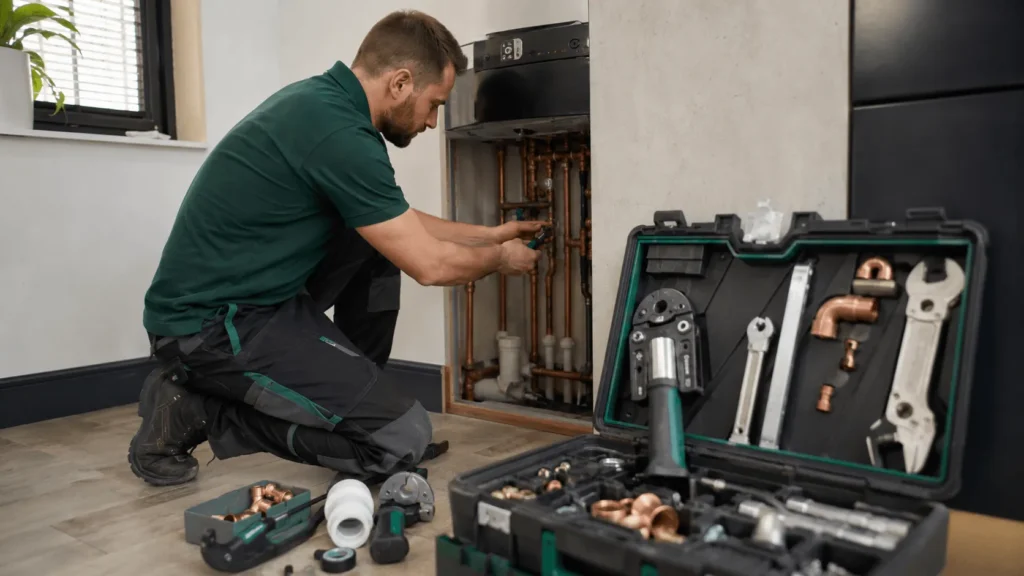
Tools bought for your plumbing business can normally reduce taxable profit, but how you claim them depends partly on your accounting method.
Examples include:
- pipe cutters and pipe benders
- pressing tools
- drills and power tools
- blow torches
- drain rods
- pressure testing equipment
- inspection cameras
- ladders
- hand tools and tool storage
Cash basis has been the default accounting method for eligible self-employed businesses since the 2024/25 tax year. Under cash basis, qualifying equipment used in the business is generally dealt with through business expenses. Under traditional accounting, equipment kept for use in the business can instead fall within the capital allowance rules.
This distinction is easy to miss when somebody simply tells you that “tools are deductible”.
Also remove any identifiable private use. If equipment is genuinely used solely for plumbing work, that calculation is much simpler.
For a broader comparison of trade expenses, see our guide to allowable expenses for tradespeople.
Van and vehicle costs for self-employed plumbers

Your van can be one of the highest costs in a plumbing business.
HMRC allows qualifying business vehicle costs including fuel, insurance, repairs, servicing, parking, vehicle tax, hire charges and breakdown cover. Private travel does not qualify.
There are two main approaches.
Actual van costs
Under the actual cost method, you record qualifying running costs and claim the business proportion.
For example, that could include:
- diesel or petrol
- insurance
- servicing and repairs
- MOT costs
- vehicle tax
- breakdown cover
- qualifying hire costs
- business parking
Where the van also has personal use, the private proportion needs to be removed.
Simplified mileage
Eligible sole traders can use HMRC’s simplified mileage method instead of calculating actual vehicle running costs.
For cars and goods vehicles in the 2025/26 tax year,, the rate is:
| Business mileage | 2025/26 rate |
|---|---|
| First 10,000 business miles | 55p per mile |
| Business miles above 10,000 | 25p per mile |
HMRC confirms these were the rates applying up to and including the 2025/26 tax year.
For example, 12,000 business miles in the 2025/26 tax year would produce:
10,000 × £0.55 = £5,500
2,000 × £0.25 = £500
Total simplified vehicle expense = £5,500 for 2025/26
Do not then add fuel, insurance and servicing for that same vehicle. Those running costs are already represented by the simplified mileage calculation. Parking and certain other travel costs can still sit outside the mileage calculation where HMRC’s rules permit them.
Check HMRC simplified vehicle expenses
Travel from home to plumbing jobs
This area deserves more care than the usual statement that “home to work travel cannot be claimed”.
HMRC recognises an exception for an itinerant trade, where someone works at a succession of temporary locations rather than travelling to a permanent business base.
HMRC’s own guidance uses a jobbing builder as an example and says that travel from home to temporary sites may qualify where the home is the base of an itinerant trade. Separate HMRC guidance says subcontractors working at two or more different sites during a year will normally be allowed travel expenses between home and those sites.
That does not mean every plumber can claim every journey from home.
A plumber travelling to changing customer properties has different facts from somebody travelling every day to the same permanent workshop or long term business base.
Practitioner check: establish the actual pattern of work before categorising the mileage. The postcode in the mileage log is not enough on its own.
Materials and parts used on plumbing jobs
Materials bought for customer work are normally part of the cost of running the plumbing business.
Common examples include:
- copper and plastic pipe
- fittings and connectors
- valves
- taps and sanitary fittings
- radiators
- boilers supplied as part of a job
- solder and flux
- PTFE tape
- sealants
- fixings and other consumables
HMRC allows the cost of stock, raw materials and direct costs connected with producing or supplying goods as business expenses.
Make sure the corresponding customer income is recorded correctly as turnover. Buying a boiler for a customer does not mean you simply remove the customer’s reimbursement from your sales records.
Materials under CIS are a separate calculation
If you carry out subcontract plumbing work under the Construction Industry Scheme, do not confuse the income tax expense treatment with the CIS deduction calculation.
Where you directly paid for qualifying materials used on the particular construction contract, the contractor can exclude their direct cost before calculating the CIS deduction. HMRC may expect evidence that you paid for those materials yourself.
That calculation determines how much CIS the contractor deducts.
Your business accounts still need to record the income and the allowable cost correctly when calculating your actual trading profit.
That distinction is particularly important when reconciling merchant receipts against CIS payment and deduction statements.
If CIS has already been deducted from your payments, read our guide on how to claim a CIS refund.
Work clothing and PPE
HMRC permits protective clothing needed for your work and genuine uniforms.
For a plumber, that can include items such as protective boots, gloves, eye protection and specialist safety clothing where they are required for the work.
Ordinary clothing does not become an allowable business expense simply because you only wear it on plumbing jobs. HMRC specifically excludes everyday clothing even when it is worn for work.
There is also an important distinction between self-employed plumbers and employed plumbers.
HMRC publishes occupational flat rate expenses for certain employees, including plumbing occupations. Those employee flat rates are not the method a self-employed sole trader uses to calculate plumbing business expenses.
Gas Safe registration and trade memberships
If gas work forms part of your existing plumbing and heating business, the cost of maintaining the registrations required to carry out that work should be reviewed as a business regulatory cost under the normal business purpose rules.
This is not a special “plumber allowance”. The underlying question is why the cost was incurred and whether it relates to the existing trade.
HMRC separately confirms that trade body and professional organisation membership relating to the business can qualify as an allowable subscription.
Keep the invoice or renewal confirmation rather than recording a round annual estimate.
Training and qualifications
Relevant training can be an allowable expense for a self-employed plumber.
HMRC permits training that helps you:
- improve skills already used in your business
- keep up with technology used in your industry
- develop skills related to changes in the industry
- develop administrative skills that support the existing business
Training designed to start a completely new business or expand into an unrelated area does not qualify under the same rule.
This makes the purpose of the course important.
A refresher course connected with plumbing or heating work you already provide is different from paying for training to establish a completely unrelated trade.
Business insurance
Insurance taken out for the plumbing business can generally be included as an allowable business cost.
That can include relevant policies such as public liability insurance, professional indemnity insurance and other insurance covering the business. HMRC specifically identifies professional indemnity and public liability insurance as allowable examples.
Where a policy covers both private and business risks, check whether the business element can be identified rather than automatically claiming the complete premium.
Phone, software and business administration

The smaller recurring costs are easy to overlook because they arrive across different bank accounts and subscriptions.
Depending on the facts, a self-employed plumber may also have allowable costs for:
- the business proportion of mobile phone charges
- business internet use
- invoicing or bookkeeping software
- website costs
- advertising
- stationery and printing
- postage
- card processing and business banking charges
- business-related accountancy work
HMRC allows business phone and internet costs, relevant software, website costs, advertising, financial charges and qualifying professional fees. Mixed personal use must be removed.
One useful distinction concerns accountancy fees. Work relating to the plumbing business can qualify, but HMRC specifically says the cost of preparing and submitting your personal Self Assessment tax return itself is not an allowable business expense.
If receipts and merchant invoices are becoming difficult to reconcile, our bookkeeping service for tradespeople can keep the expense records organised throughout the year.
What a self-employed plumber cannot claim
Some costs remain private or are specifically excluded even though they arise while you are running a business.
| Cost | General treatment |
|---|---|
| Ordinary everyday clothing | Not allowable |
| Private part of phone or vehicle costs | Not allowable |
| Normal personal meals | Generally not allowable |
| Fines and penalties | Not allowable |
| Client entertaining | Not allowable |
| Money taken from the business for yourself | Not an expense |
| Personal Self Assessment preparation | Not an allowable business expense |
| Private travel | Not allowable |
HMRC permits meals associated with qualifying overnight business travel, but that is different from an ordinary lunch bought during the working day.
Keep evidence for the expenses you claim
HMRC says you should keep records and evidence of business expenses even though you do not normally send the receipts with your Self Assessment return.
For the 2025/26 tax year, a self-employed taxpayer filing by the normal deadline should retain the relevant business records until at least 31 January 2032.
A useful records file for a plumber normally includes merchant invoices, tool receipts, mileage records, insurance documents, training invoices, software subscriptions and CIS payment and deduction statements where relevant.
Let Us Handle Your Tax Return
The useful question is not how many expenses you can find. It is whether each cost has been recorded under the correct rule, with the private element removed and evidence available if HMRC asks.
If you want Hammer & Ledger Tax to prepare your return and check your plumbing business expenses, contact us about your tax return.
Frequently Asked Questions
Can a self-employed plumber claim tools on tax?
Yes, qualifying tools bought for your plumbing business can normally reduce taxable profit. The exact treatment can depend on whether you use cash basis or traditional accounting and whether the equipment has any private use.
Can I claim my plumbing van on Self Assessment?
Qualifying business van costs can be claimed using actual costs or, where eligible, simplified mileage. For the 2025/26 tax year, the simplified rate is 45p for the first 10,000 business miles and 25p after that.
Can a plumber claim work boots and clothes?
Protective clothing needed for plumbing work can qualify, including appropriate protective boots and PPE. Ordinary clothing does not qualify simply because you wear it at work.
Can I claim Gas Safe registration as a business expense?
Where Gas Safe registration relates directly to gas work already carried on within your plumbing and heating business, it would normally be reviewed as a business regulatory cost under the normal business purpose rules.
Can a plumber claim food while working?
Normal daily meals are generally personal costs. HMRC allows reasonable meal costs in some qualifying situations involving necessary overnight business travel, so the reason for the journey and expense matters.
Not Sure What You Can Claim?
Send us your receipts and we’ll tell you exactly what’s claimable, or use one of our free checkers for an instant answer on a specific expense or business structure question.

Mustafa Rehman
Mustafa Rehman is an ACMA and CGMA finance professional who contributes practical financial insight to Hammer & Ledger. His professional background includes financial reporting, finance transformation, post-acquisition integration and management accounting, helping support clear and useful content for UK businesses and tradespeople.